
At the beginning, manual Telegram selling can feel manageable.
You answer product questions yourself, confirm payments one by one, send order updates when customers ask, and keep stock in a spreadsheet that mostly works. For a small number of orders, that setup can even feel flexible. You stay close to customers, you see every conversation, and you do not need to think much about systems yet.
But there is a moment when “manageable” quietly becomes expensive.
Not because your business is failing. Usually the opposite. Orders start coming in more often. More people ask the same questions. More customers reach checkout but do not finish. More payment confirmations pile up. More follow-ups depend on whether someone on your team remembers to send them.
That is usually the real turning point. The issue is no longer whether Telegram can sell. It is whether your workflow can keep up.
If your goal is to grow a real Telegram Bot Shop instead of running sales through memory, screenshots, and manual follow-ups, these are the clearest signs that it may be time to automate.
Why manual Telegram selling works until it doesn’t
Manual selling often survives longer than it should because the first version feels lean.
You can launch quickly. You can test demand. You can learn what customers ask before building anything more structured. For early validation, that is not a weakness. It is often the fastest way to prove there is real buying intent.
The problem starts when the same manual habits remain in place after the store already deserves better infrastructure.
That is when simple tasks begin to create hidden costs:
You answer the same support messages every day.
You confirm payments manually even after volume increases.
You update stock too late.
You lose track of which orders need action.
You recover fewer buyers than you should after checkout drop-off.
At that stage, the problem is not effort alone. It is lost revenue, slower operations, and a customer experience that becomes less consistent as you grow.
This is where telegram store automation stops being a nice extra and starts becoming operationally necessary.
1. You confirm payments manually more often than you should
One of the first warning signs is how much time your team spends just verifying whether an order is really paid.
When that process depends on checking screenshots, matching names, reviewing payment notifications manually, or replying one customer at a time, the store becomes slower than it needs to be. It also creates avoidable uncertainty for buyers.
Customers want a simple sequence: select product, pay, receive confirmation, know what happens next.
If your current setup makes that feel inconsistent, trust drops fast. This is also why the ability to accept payments in Telegram cleanly matters so much. The payment step is not only financial. It shapes confidence.
2. Your order status lives in chats, not in a real workflow
A store becomes fragile when order handling depends on chat history.
If you have to scroll conversations to remember whether something was already paid, packed, sent, or delivered, you do not really have order management. You have fragmented memory.
That creates problems fast:
- orders get delayed
- support answers become inconsistent
- fulfillment depends on who is online
- customers ask again because the status is unclear
Once this starts happening regularly, you need a cleaner structure for Telegram order tracking and post-payment workflow.
A growing store cannot rely on “I think we already handled that.”
3. Stock updates happen too late
Overselling does not always happen because demand is huge. Sometimes it happens because inventory visibility is weak.
Manual Telegram selling often handles stock reactively. A product is sold, someone forgets to update quantity, another customer buys it, and now the business has to apologize, refund, or improvise.
That creates friction on both sides:
the customer loses confidence, and your team loses time fixing a preventable issue.
This is one of the clearest signs that your store has outgrown a manual setup. Inventory does not need to be dramatic to hurt conversion. It only needs to be unreliable.
4. Customer support is repetitive and always urgent
If the same questions appear every day, support is giving you a roadmap.
Questions like:
Where is my order?
Was my payment received?
How long is delivery?
Do you still have this item?
Can I change my order?
Those messages are not only support requests. They are signals that the store is missing better communication and better automation.
Manual support creates two problems at once. First, it steals time from sales and operations. Second, it trains customers to wait for a person instead of trusting the system.
That is where telegram store automation helps most: not by removing human support, but by reducing the number of predictable messages that should never require manual attention in the first place.
5. Checkout drop-off is becoming harder to recover
A buyer can be interested and still disappear.
That is normal in ecommerce. But when the checkout flow in Telegram depends too much on manual follow-up, abandoned buyers slip away faster than they should. No one has time to chase every partial intent one by one.
Weak recovery also makes Telegram abandoned checkout more expensive than it looks. It is not only a conversion issue. It is a workflow issue.
If your store cannot consistently trigger the right reminders, confirmations, or next-step messages after a buyer hesitates, then every missed checkout becomes harder to recover at scale.
6. Your team cannot see what is working every week
Manual setups often produce activity, but not clarity.
You may know that orders are happening. You may feel busy. But that does not mean you know:
- where customers drop off
- which products convert best
- which messages help close a sale
- which payment points create friction
- which repeat buyers are worth nurturing
That lack of visibility becomes a serious bottleneck once you want to improve results intentionally instead of just reacting.
Growth gets easier when your store gives you data you can use, not just conversations you can search through later.
7. The business depends too much on one person
This is one of the most dangerous stages because it often looks efficient from the outside.
One founder knows the products. One operator knows how orders move. One support person knows which messages to send. One team member remembers which buyers need follow-up.
It works until that person is unavailable, overloaded, or simply misses something.
If a store depends too heavily on one person’s memory, your business is more fragile than it looks. A real store should run through systems, not heroic effort.
That is usually the strongest sign that manual Telegram selling has reached its limit.
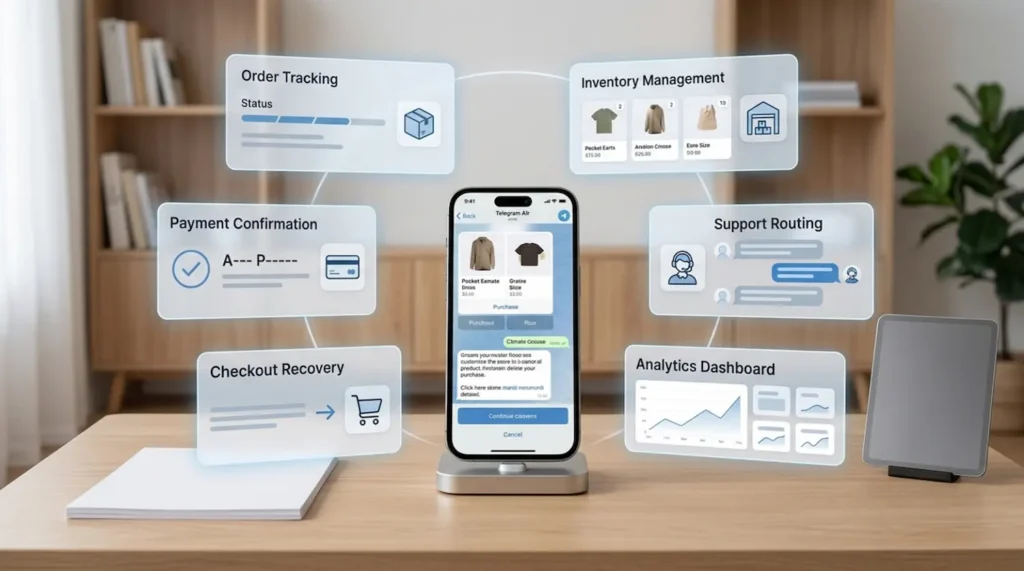
What to automate first in a Telegram store
Not everything needs to be automated at once.
The smartest move is usually to start with the points where friction repeats every day and where delay directly affects trust or conversion.
In most stores, that means:
- payment confirmation
- order status updates
- stock visibility
- checkout recovery
- post-purchase messaging
- repeated support answers
This is the point where many teams stop comparing effort alone and start comparing systems.
It is also where decisions around Telegram shop pricing become more practical. The cheapest setup is not always the one with the lowest monthly cost. It is the one that removes enough manual work to protect sales, time, and customer confidence.
When manual selling is still fine
Not every store needs automation immediately.
If you are validating a new offer, processing very low order volume, and still learning how customers buy, manual selling can be a smart temporary phase. It keeps the feedback loop close and the setup light.
The mistake is not starting manually.
The mistake is staying manual after the workflow already shows clear friction.
There is a big difference between an early-stage test and an operating model that is quietly limiting growth.
Manual vs automated: what really changes
The biggest shift is not just speed. It is consistency.
With a more automated setup, the store can:
- confirm actions faster
- reduce repetitive support
- give buyers clearer next steps
- lower operational mistakes
- make weekly optimization easier
- create a more reliable buying experience
That does not mean everything becomes hands-off. It means the team spends less time patching the process and more time improving it.
If you are already weighing platform decisions, that is also why some businesses start comparing structured solutions against custom Telegram bot development. The real question is not whether something can be built. It is whether it can be run, improved, and scaled without unnecessary friction.
The store that grows should not depend on memory
Manual Telegram selling can help you start fast. It should not be the reason growth becomes harder later.
Once payments, support, stock, follow-ups, and order handling begin to rely too much on memory and manual effort, the issue is no longer hustle. It is system design.
A better setup does not just save time. It protects trust, reduces avoidable errors, and gives your business a cleaner path to scale.
If that is where your store is now, the next useful step is simple: complete the Trapyfy Store Onboarding Intake and map a setup that helps you launch, manage, and grow without carrying the whole workflow by hand.
Leave a Reply