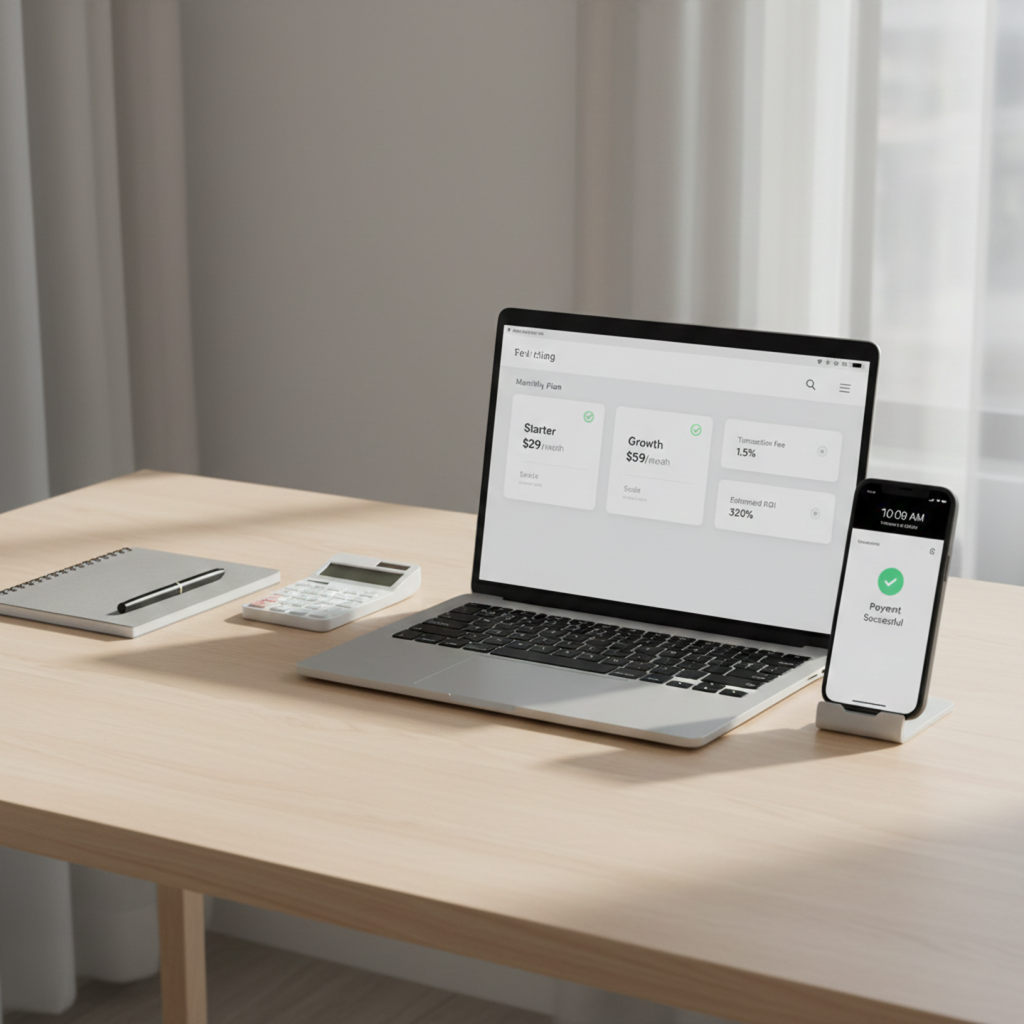
If you’re evaluating tools to sell on Telegram, price is usually the first thing you check—and often the most misunderstood. Many teams compare monthly plans, pick the cheapest one, and later discover extra costs in payments, automation, integrations, or support.
This guide breaks down Telegram shop pricing the right way: what you actually pay, where hidden costs appear, how to calculate ROI, and how to choose a plan that supports growth instead of limiting it. If your goal is to launch or scale a Telegram store with predictable margins, this is the framework you need. In this guide, we break down Telegram shop pricing step by step.
Telegram shop pricing: what it really includes
Most people think pricing = monthly subscription. In reality, your total cost usually includes multiple layers:
- Platform subscription fee
- Payment processing fees
- Transaction or volume-based fees
- Integration or API-related costs
- Automation/message costs (depending on provider)
- Team seats and permission tiers
- Onboarding or support plan upgrades
When comparing a telegram bot shop pricing page, always evaluate total operating cost, not just the headline plan.
Fixed costs vs variable costs in a Telegram store
Understanding Telegram shop pricing at both fixed and variable levels prevents margin surprises. To make clean decisions, separate costs into two buckets.
Fixed costs
These are predictable every month:
- Software subscription
- Basic integrations
- Essential tools (analytics/helpdesk if external)
- Standard support tier
Variable costs
These grow with sales or usage:
- Payment processing percentages
- Per-transaction fees
- Message/event volume fees
- Chargebacks/refunds
- Premium support at scale
A low fixed cost can still become expensive if variable costs are high. That’s why telegram ecommerce pricing should always be modeled against expected monthly order volume.
Hidden costs most sellers miss
The biggest pricing mistakes happen when teams ignore non-obvious expenses. Watch for these:
1) Checkout performance costs
A platform with weak checkout UX may look cheap but reduce conversions.
If checkout drop-off is high, your “cheaper” tool becomes the most expensive option in lost revenue.
2) Add-on dependency
Some platforms keep core features behind add-ons:
- Abandoned checkout recovery
- Advanced analytics
- Automation workflows
- Multi-user access
3) Migration costs
Switching later may require:
- Data cleanup
- Flow rebuilds
- Retraining team members
- Temporary downtime risk
4) Support bottlenecks
If critical support is only available on higher tiers, downtime can cost more than the plan difference.
These hidden factors are why telegram shop software pricing should be compared with a full operational lens.
How payment fees impact your real margin
Payment costs are often the highest variable component in a Telegram store. Even small fee differences compound quickly.
Use this quick margin view:
- Gross revenue = orders × average order value
- Payment fees = gross revenue × payment fee % + per-transaction fees
- Platform cost = fixed monthly + variable platform fees
- Operational overhead = support, tools, chargebacks, refunds
- Net operating margin = gross revenue − total monthly costs
If two tools are similar in subscription price, the winner is usually the one with:
- Better checkout conversion
- Fewer failed payments
- Lower operational friction
That combination often delivers higher net margin than a lower sticker price.
A practical ROI formula for Telegram shop software
Before committing, estimate return with a simple model.
ROI formula
ROI (%) = ((Incremental monthly profit − monthly platform cost) / monthly platform cost) × 100
What counts as incremental monthly profit?
- Extra sales from better checkout flow
- Better conversion from trust/security signals
- Time saved via automation (team cost reduction)
- Recovery of failed or abandoned checkouts
If a platform costs more but consistently lifts conversion and reduces manual work, ROI can still be significantly higher.
Pricing scenarios by growth stage
Not every business should buy the same plan. Choose based on stage and constraints.
Starter stage (validation mode)
Best for teams testing offer-market fit.
Priorities:
- Fast setup
- Clean checkout
- Essential analytics
- Affordable baseline
Avoid:
- Overbuying advanced features before traction
Growth stage (consistent monthly sales)
Best for teams with repeat orders and active promotion.
Priorities:
- Conversion optimization
- Order automation
- Better payment reliability
- Stronger reporting
Avoid:
- Staying on a starter plan that blocks scaling
Scale stage (high volume, multi-operator)
Best for teams with complex workflows and performance targets.
Priorities:
- API/webhooks
- Advanced permissions
- Security/compliance depth
- Priority support and uptime reliability
Avoid:
- Platforms that require constant manual work at high volume
How to choose the right plan without overpaying
Use this decision sequence:
- Define your expected monthly orders and average order value
- Estimate payment mix (card, crypto, local methods)
- Map must-have features for your current stage
- Compare total monthly cost at your projected volume
- Stress-test support quality and reliability
- Check upgrade path (can you scale without migration?)
This keeps your decision tied to outcomes, not feature hype. Before locking your budget, make sure your store setup is solid—this guide shows how to create a Telegram shop without coding so your pricing decision matches real operational needs.
Comparison checklist before you commit
Before purchasing any plan, confirm all of this:
- Pricing is transparent (subscription + transaction logic)
- Checkout is optimized for mobile Telegram users
- Core automation is included or clearly priced
- Security practices are documented and credible
- API/integration roadmap matches your next 6–12 months
- Analytics shows funnel drop-offs, not only top-line numbers
- Support response times are clear for your tier
If any of these are unclear, ask before you commit.
Your smartest next move before picking a plan
Choosing a platform is not about finding the cheapest monthly number. It’s about selecting a system that protects margin, supports conversion, and scales with your store.
If you’re evaluating options now, do this next:
- Model your real monthly cost at current and target volume
- Validate checkout quality and payment reliability first
- Prioritize automation and analytics that save time every week
- Pick the plan that gives you the best profit trajectory, not just the lowest entry price
That’s the difference between “paying for software” and investing in a Telegram sales engine. Use this framework to turn Telegram shop pricing into a growth decision, not just a cost decision.
FAQ
What is included in Telegram shop pricing?
Telegram shop pricing usually includes a base subscription plus variable costs like payment fees, transaction-related fees, add-ons, or advanced support tiers.
What is a good starting budget for a Telegram store?
A good starting budget depends on order volume and payment mix. Most teams should model fixed software cost plus payment fees and a small operational buffer.
How do I compare telegram bot shop pricing plans correctly?
Compare total monthly cost at expected volume, not only subscription price. Include checkout performance, automation, support, and integration limits.
Is the cheapest Telegram shop plan always better for beginners?
Not always. A slightly higher plan with better checkout and automation can produce higher profit by improving conversion and reducing manual workload.
How can I estimate ROI before buying Telegram shop software?
Use projected incremental profit from conversion gains and automation savings, then compare that against total monthly platform cost using a simple ROI formula.
Leave a Reply